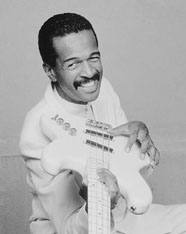
The funk tradition of the '60s and '70s produced more than its share of unsung virtuosos--players whose styles and sounds have become staples of the pop-music vocabulary, leaving indelible marks on our ears and minds. Things like chicken-scratch guitar, wah-wah keyboards, stuttering horns, and ear-popping drum work trace their roots to such musicians as guitarists Jimmy Nolen and Leo Nocentelli, keyboardists Billy Preston and Bernie Worrell, horn players Fred Wesley and Maceo Parker, and drummers Clyde Stubblefield and Jabo Starks. But when you want to hear the most influential, distinctive, innovative funk musician of all time, there's only one name you need to know: Larry Graham, a.k.a. Mr. Thunderlicks, the original--and still supreme--thumb-slapper.
At age 50 (as of August 14), Graham can still rattle sternums and rearrange tectonic plates, and the mere mention of his name can cause even a bass Stagolee like Bootsy Collins to gush. "When I got with Funkadelic," remembers Bootsy, "Larry once invited me up to his room to jam. He handed me his bass, and I said, `Don't even try it. You play the bass, and I'll watch.' I will never be able to do that technique as well as he does. He's the ultimate slap machine."
Nonetheless, Graham--who currently lives in Montego Bay, Jamaica--may be the most influential bassist nobody knows. Sure, he's a household name to the bass cognoscenti, but the world at large thinks of him only as the voice behind the 1980 hit ballad "One in a Million You." Most folks don't remember him for his groundbreaking work with Sly & the Family Stone, nor do they think of him as the man who defined an entire musical genre with his thumb. It's not because Larry has retired; in fact, he's been touring with a new version of Graham Central Station since 1992, wowing audiences in Japan and Europe. ("They go crazy for the funk over there," he says.) Last year the group lit up the stage with a torrid performance at the House of Blues in L.A., and Larry also performed with Parliament/Funkadelic at the Rock & Roll Hall of Fame induction ceremony. (He and the rest of Sly & the Family Stone were inducted in 1993.)
People may not know Graham's face or name, but they know his sound--even when they hear it done by someone else. Pop chanteuse Brandy's hit "Sittin' Up in My Room" [Waiting to Exhale soundtrack, Arista], for example, is anchored by a replica of Graham's famous "Thank You (Falettinme Be Mice Elf Agin)" bass line. [Ed. Note: For a transcription of Graham's original line, see September '92.] Louis Johnson, Marcus Miller, Stanley Clarke, Me'Shell NdegéOcello, Les Claypool, Flea ... anyone who has ever whomped a bass string or snapped it off the fingerboard is honoring the most honorable Mr. Graham.
Although slapping had been used by upright players for decades (Milt Hinton and Cuban legend Israel "Cachao" López are good examples), Graham's thunder-thumb approach--first with Sly and later with Graham Central Station--turned the electric bass world on its ear. "I was in high school when I first heard Larry," says Jamaaladeen Tacuma, who played with Ornette Coleman's Prime Time band and has several acclaimed solo albums under his belt. "I thought, Man--this is crazy ... this makes no sense." Graham, however, still has an aw-shucks attitude about his status. "The thing is, I never saw myself as a revolutionary," he said just before the recent release of The Best of Larry Graham and Graham Central Station, Vol. 1. "All I was doing was what sounded good to me. But it has become an accepted way of playing the bass, to the point where people take it for granted. Most of the young kids you see doing thump-and-pluck don't even know who I am. Even people who came to my shows back in the old days didn't know I was the man behind the bass in Sly & the Family Stone."
Oakland Roots
Though he's Texan by birth, most of Graham's musical and personal growth took place in Oakland, California. His family--which included a guitar-playing father and a jazz piano-playing mother--moved there when Larry was two. An early student of drums and tap dance, Graham later picked up the clarinet, guitar, and sax, listening to such musicians as Ray Charles, Nat King Cole, and Frankie Lymon & the Teenagers.
By the time he was 15, Larry was accompanying his mother at clubs around town; it was then that he started developing his playing style. "We had a trio," he remembers. "Me, my mother, and a drummer. One club we played at had an organ with bass footpedals, and I found a way to use the footpedals while playing the guitar." When the organ broke down, Graham switched to bass, hoping to fill in the low end until the organ was back in commission. As fate would have it, the organ never got fixed, leaving Larry on an instrument he never intended to play full-time. "So I went out and got an old St. George bass. I wasn't concerned with playing it in the traditional way, because I didn't see myself as a bass player. In my mind, I was still a guitar player, so I didn't care that bass players might think I couldn't play or was doing it wrong." Then something even more crucial happened: the band lost its drummer, which left Graham as the entire rhythm section. "That's when I started thumping with my thumb. It was the only way I could get that rhythmic sound."
In the process, Graham tapped into not only a new sound but an extremely powerful musical legacy. The "every-instrument-a-rhythm-instrument" concept is a major part of West African music and has found its way into all African-derived styles, including Afro-Cuban, Afro-Brazilian, reggae, and rock. The layered rhythms of Bo Diddley, the famous New Orleans "second line" style, and the soul-funk of James Brown all have roots in the musical approaches of West Africa and Afro-Latin America. But Graham didn't just adopt a rhythmic attitude: he transferred actual drum figures to the bass. His thumb would play the kick-drum parts, and his plucking fingers would simulate snare rhythms. This simple-sounding concept turned the bass into a hybrid instrument, capable of interacting with a drummer or percussionist with the same force as a conga, timbale, or trap drum while still holding down a supportive, melodic role.
Like A Rolling Stone
Graham mastered his new approach while he and his mother gigged around San Francisco's Haight-Ashbury scene. After a few shows at a place called Relax With Yvonne in 1968, Larry caught the attention of a popular local deejay named Sylvester Stewart--also known as Sly Stone--who was looking to put together his own band. "One particular woman came in all the time and loved us," Larry remembers, "and she was also a fan of Sly, who was on KSOL radio at that time. When she heard Sly was trying to put together a band, she told him to come check us out. And he did."
 Needless to say, Stone was impressed. Graham--armed with either a Fender
Precision or a Vox bass--soon was part of what was to become one of pop's
greatest outfits. Sly's songwriting and arranging genius and the Family Stone's
churning rhythms garnered the band fans from Haight-Ashbury to New York's 125th
Street.
Needless to say, Stone was impressed. Graham--armed with either a Fender
Precision or a Vox bass--soon was part of what was to become one of pop's
greatest outfits. Sly's songwriting and arranging genius and the Family Stone's
churning rhythms garnered the band fans from Haight-Ashbury to New York's 125th
Street.
Drummer Greg Errico propelled that rhythm. Graham had felt his style might explode when set against a percussion instrument, but in Errico he found a near-perfect match: a drummer powerful enough to match Larry's aggressive playing yet sensitive enough to leave space. "Greg knew how to play around me instead of colliding with me," Graham says. "He wasn't busy to the point where there wasn't any room to do anything. He was a solid foundation man--and that's where all the good funk starts, at the bottom. It's just like building a house."
As Sly's music grew in popularity, so did Graham's bass style. According to Larry, it took a while for the thump-and-pluck technique to catch on--but once it did, it spread like mad. Sly's songs were hits, which meant that if you were playing his songs in a cover band, you had to play Graham-style bass. At the time, that was a daunting task for even the most talented players. "I first saw Larry around the time I was with James Brown," says Bootsy. "I thought, How is this cat playing with his thumb? He was doing amazingly unheard-of things."
Despite the many high-profile players who followed in his wake, Graham's pick as the next-best thumb-slapper is Kenny Burke, who played with the R&B group the Five Stairsteps. "Kenny used to hang around a lot during the early Sly days," says Larry, "so he picked up that technique directly from me. At the time, there wasn't a bunch of guys copying me yet, and there was no such thing as an instructional video--so a bass player had no way to find out what I was doing unless he saw me at a show, and even then he still might not know. But Kenny was right there with me from the beginning, so he had a head start on everybody."
Soon Sly and Larry were riding high on a string of hits--but the group's fame and success magnified Stone's egocentric and often self-destructive tendencies. By the early '70s, his behavior had become increasingly erratic, resulting in a slew of missed appointments and concert no-shows. Sly also alienated band members by overdubbing tracks himself, including several on the epochal There's a Riot Goin' On. Still, Graham was a strong presence, making a huge contribution on hits like "Smilin' (You Caught Me)" and "Runnin' Away," as well as the crushing slow-groover "Thank You for Talkin' to Me Africa," from Riot. But the internal and external pressures spelled doom for the Family Stone. "I wasn't the first one to leave," says Larry. "I left in 1972, but it had started to deteriorate long before that. There's always a chance we'll get back together, as long as Sly is alive and working. But that's on him. It's his decision."
The Station Mutation
The disintegration of the original Family Stone left the door open for Graham to form his own group, something he hadn't thought about until the Stone situation became too much to take. Even then, he wasn't interested in performing. He had planned to write for and produce a group he had assembled called Hot Chocolate--but after a single jam with Graham, everyone knew Larry was going to be the bassist.
Renaming the band Graham Central Station, Larry went on to carve his own niche. While Sly's success lay in his ability to meld deadly beats with unforgettable pop hooks, Graham Central Station's sound ran the gamut from ballads to doo-wop and excelled at over-the-top, take-no-prisoners funk. It seemed nothing made them happier than setting a groove loose--giving it a good running start and then running it down like a pack of hunting dogs (as on the eight-minute workout "The Jam," issued as a single and available on The Best of Larry Graham and Graham Central Station, Vol. 1). And Graham's bass was usually leading the charge.
"When we wrote songs for Graham Central Station," Larry remembers, "we'd often start with the bass line. On `Hair,' for example [Graham Central Station], the drums were built around the bass pattern. And when we did covers, like our version of Al Green's `It Ain't No Fun to Me' [Graham Central Station], it would always sound like us, because I'd play the bass line in my style."
Standing In The Shadows
Even as the Larry Graham sound spread throughout the music world, his name remained unrecognized by the general public. That got even worse as things got better. He scored the biggest hit of his career, "One in a Million You," in 1980 [One in a Million You] --only it was his voice, not his fingers, that brought him fame. The lush R&B ballad, which showcased Larry's full-grain baritone, earned him his highest visibility as the tune shot to #1 on the R&B charts and #9 on the pop charts. "One group of fans would come to shows all dressed up for ballads, and the other would be in jeans, wanting to hear the funky stuff. But when I went onstage, people found out the `One in a Million' guy was the same person behind the funk."
Things are a little better now, says Graham. There's more education about the music, and more and more people are waking up to his playing. "When it comes to who the musicians are, people generally don't know any better," he says. "But the music speaks for itself. You play some of the old funk stuff for a kid today, and he'll go, `Wow! What's that new jam?' It's not new--it just sounds good because it's always going to be good music."
It's hard to imagine Larry Graham without his white, Japanese-built Moon custom bass. He designed it back in 1982, inspired by an old Fender Jazz he had used with Graham Central Station. That axe sported a body-mounted microphone that helped Larry to sing and play at the same time. ("We had to rebuild the mike after every show," says Graham's tech, David Hampton. "Larry would absolutely destroy it--sometimes before he even got to the performance. He soundchecks the same way he performs--full out--and the microphone couldn't take it.") The Moon bass has Bartolini pickups and is strung with light-gauge GHS Bass Boomers. Graham runs his signal through a Morley Volume pedal with an A/B switcher, a Roland Jet Phaser, a Mu-Tron Octave Divider, and an old Morley Fuzz Phaser, which he first used on "Aint No Bout Adoubt It."
According to Hampton, working for Graham requires an extensive knowledge of analog electronics. Larry loves vintage effects, and Hampton has often had to revive equipment that hasn't been plugged in since the '70s. "It's interesting," says David. "When we go out to vintage shops looking for things, Larry associates certain effects with certain songs. That's because back in the early days, people would actually write the song around the effect."
Graham started using Sunn amps when he was with Sly Stone; he moved on to Fenders and then settled on an Acoustic 360, "the kind with the folded horn." Today, Larry's Hughes & Kettner rig includes a 650-watt BassBase 600 hybrid head, which drives BC 410 and BC 215 cabinets. "A lot of people are fussy about the specifics of their sound," says Hampton, "but Larry's thing is just to turn it up until the stage rumbles. When it starts shaking, he knows he's got it right. It may sound simple, but that's his way of doing it--and there is only one Larry Graham."