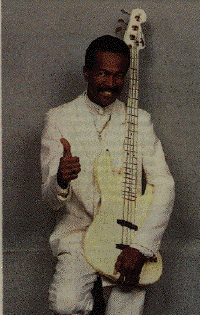
The Thumb that Launched a Thousand Slaps: Larry Graham today,
with his bass "Moonshine," made by the Japanese company Moon.
Eventually, Graham and his mother made another historically significant move when they decided to drop the drummer and work as a duo. "That was when I started to thump the strings with my thumb to make up for not having the bass drum," Larry notes, "and I also plucked [i.e. popped] the strings with my index finger to fill in the snare backbeat. Over time, I got it down pretty good, but I wasn't thinking in terms of creating anything new; I was just trying to do my job -- to provide as much of a foundation as I could."
Meanwhile, Sylvester "Sly" Stewart was working as a DJ at Bay Area radio station KSOL and hatching plans to start a band. Unbeknownst to Graham, a female fan of the duo began calling the station and imploring Sly to check out Larry's ear-opening basswork. "He finally showed up," Graham says, "and he liked what I was doing so much that he asked me to join his group, even though he'd been planning to play bass himself. We recorded A Whole New Thing in 1967, but it wasn't until our second album, Dance to the Music, became a hit that thumping and plucking got popular and started turning up on other records."
Internal problems eventually led Graham and other Family Stone members to begin departing in 1972. The bassist carried on, first with Graham Central Station -- a hard funkin' group that made seven albums -- and then as a solo artist, beginning with the crossover smash One in a Million in 1980. Following his fifth and final solo effort, the 1985 Japanese-released Fired Up, Larry has spent a few years away from the public eye. Since his re-emergence several years ago, he has become a sideman supreme, making concert appearances in Japan and Brazil with the Crusaders and Stanley Clarke, singing duets with Aretha Franklin and Amy Keys, and writing songs for everyone from Johnny Mathis to Stanley Jordan.
Graham's current schedule finds him busier than ever. He recently added bass and vocals to upcoming albums by Eddie Murphy and the English funk band Four Trans Five (sic) as well as singing with Sly's sister Rose on Robbie Nevil's new disc. He also provided the vocals for Carlos Santana's remake of Marvin Gaye's "Right On," and followed that with a trip to Mexico to appear in the video and several concerts. This year, his annual visit to Japan will include a Graham Central Station revival show also featuring Mimi, a Japanese pop artist produced by Graham and guitarist George Johnson. "We'll be doing some Graham Central Station, some of my solo stuff, some Brothers Johnson tunes, ansd songs George and I have written for Mimi."
Graham, who moved from Los Angeles, to Montego Bay, Jamaica, last year, still plays "Sunshine," a mid-'60's Jazz Bass prominent on many a hit. But his main bass today is "Moonshine," an updated active version of "Sunshine," custom made for him by the Japanese company Moon. He's also been using his new Peavey TL-5, a gift from Verdine White [bass player for Earth Wind and Fire], and is awaiting a Moon 5-string. "I'm really into all the new bass developments," he offers. "People ask me if I'm bitter that my technique is being used on so many hit records, but to ne it's the ultimate compliment. I feel great that I've been able to contribute something to the world of music." And more contributions are on the way: "Montego Bay is the most peaceful, creative environment I've ever been in. I have a home studio and a local band with Jamaican musicians, so there's no telling what kind of 'funk-gae' music we'll be making!"